 |
|||||||||||||
|
|||||||||||||
 |


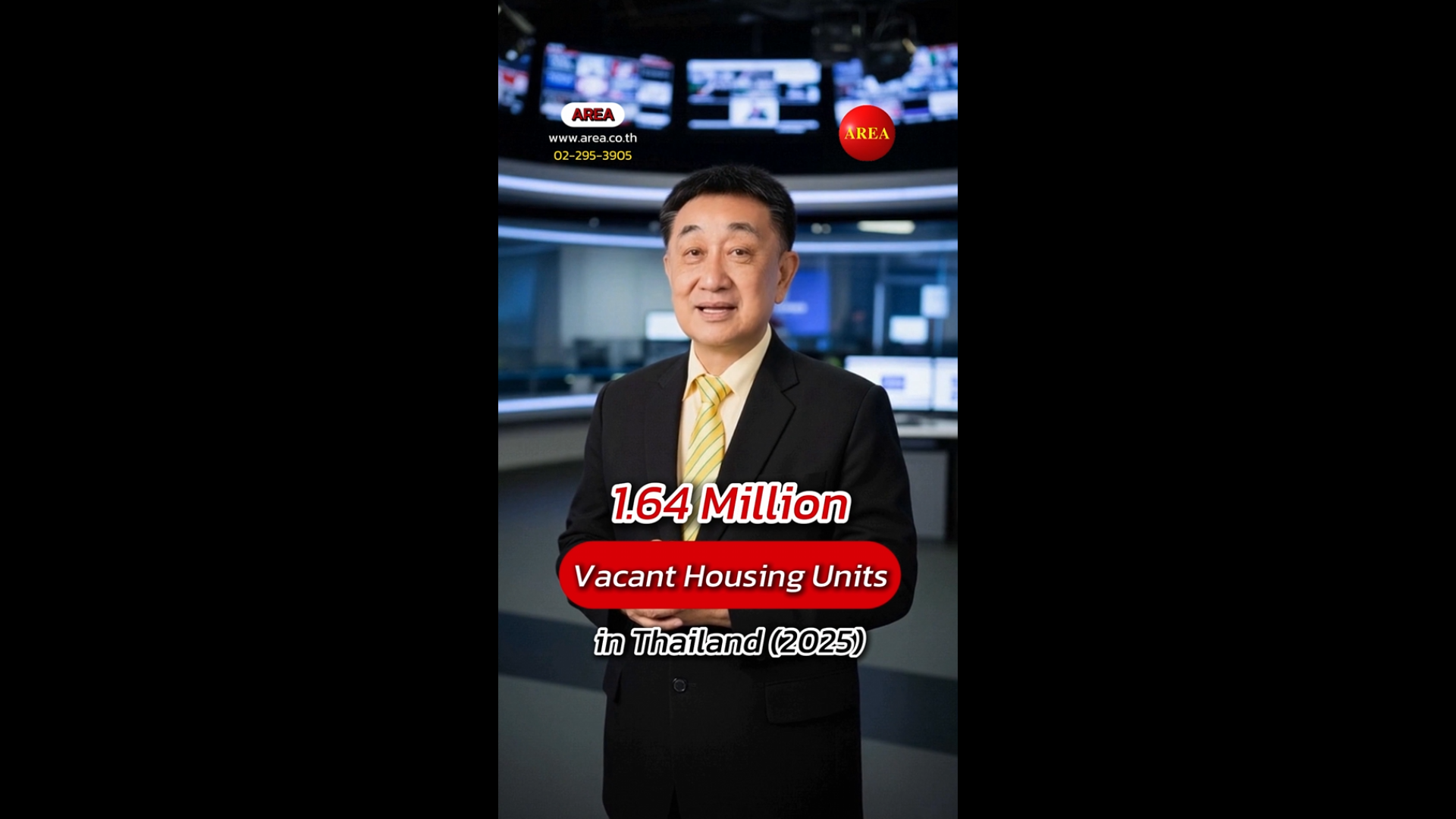
Listen to Dr.Sopon Explaining 1.64 mil Vacant Housing Units in Thailand
AREA Press Release No. 1067/2025: November 11, 2025
Dr.Sopon Pornchokchai, Ph.D. Dip.FIABCI, MRICS
President, Agency for Real Estate Affairs (AREA)
This is the VDO of the AI of Dr.Sopon Pornchokchai, President, Agency for Real Estate Affairs explains in details on the number of 1.64 million vacant housing units in Thailand as a whole.
1.64 Million Vacant Housing Units in Thailand
Vacant housing is a significant phenomenon that should be taken into consideration. Dr.Sopon Pornchokchai, President, Agency for Real Estate Affairs (www.area.co.th) which is Thailand’s first real estate information centre since 1991, has been conducting a survey of Vacant Housings since 1995 and has been monitoring the results continuously up until now.
About Vacant Housing
Unoccupied housing units are both completed low-rise houses and condominiums for sale but have not been occupied (or have electricity users of no more than 15 units per month, indicating that the house may be cleaned occasionally but not lived in). This includes detached houses, semi-detached houses, townhouses, shophouses, and condominiums that are residential units for sale. Almost all unoccupied houses are in the possession of the buyers and are mostly no longer in the hands of the land developer. Therefore, they are not the developer's responsibility in any way. However, unoccupied houses do not include apartments for rent, dormitories, or other types of residential units for rent.
Vacant housing units are one of the clearest indicators of housing market health. A high number of Vacant housing units suggests, on the one hand, that there is not a significant housing shortage. On the other hand, it may also indicate excessive speculation, leaving a large number of homes unoccupied. A high number of vacant housing units also reflects a troubled housing market, making it difficult to sell newly built homes. If developers struggle to sell their properties but could not be successful, this could also impact the stability of lending institutions.
The number of vacant housing units is crucial for both government policy planning and urban and housing developments. The figures also benefit the Metropolitan Electricity Authority, which installs meters but finds them inefficient due to low occupancy. The private sector, particularly land developers, can use this data to be more cautious and avoid developing in areas with oversupply. These vacant housing units may then compete to newly launched housing markets. Furthermore, this vacant home data will be useful to financial institutions offering loans, investors, and homebuyers who need to be informed about their home investment.
Past Vacant Housing surveys
The first survey of vacant housing units took place in 1995, when the Government Housing Bank commissioned the Agency for Real Estate Affairs to conduct the survey. The second survey, conducted again by AREA was in 1998 during the economic crisis of 1997-2001, and found a high number of vacant housing units in Bangkok and its vicinity, reaching 350,000 units, or approximately 14% of the available housing at that time.
According to a continuing study by the Government Housing Bank, analyzing the number of residences with electricity meters from the Metropolitan Electricity Authority but not using electricity at all, or using very little (no more than 15 units), or whose meters had been cancelled, this figure totaled approximately 17% of the total number of electricity users between 1996 and 2003. In the most recent survey year, at the end of 2003, there were 362,118 “Vacant housing units” (http://bit.ly/21sjMkv). However, as of January 2016, the number of residential electricity users had increased to 2,967,456 units, but there were still as many as 445,118 vacant housing units.
In May 2018, the Thai Appraisal and Estate Agents Foundation requested data from the Metropolitan Electricity Authority. Analyzing this data, extrapolating from overall data for the Bangkok Metropolitan Region, they found that there were 525,889 vacant housing units. The Bangkok Metropolitan Region is home to approximately 110,000-120,000 newly launched housing units. This means that if no new housing is produced for four and a half years, there would still be a supply of these homes available for sale on the market. This suggests a significant number of vacant housing units, but it is not yet a dangerous signal.
These 525,889 vacant Housings are calculated from the total number of 5,097,815 housing units in Bangkok and its vicinity, or approximately 10.3% of the total. This means that out of ten houses, one house will be vacant and the other 9 houses will be occupied. This proportion has decreased compared to the crisis period 20 years ago. In 1995, Dr.Sopon found 14.5% of all housing units vacant at that time. Later in 1998, approximately 12.0% of all housing units were vacant. The proportion of vacant Housings therefore decreased accordingly.
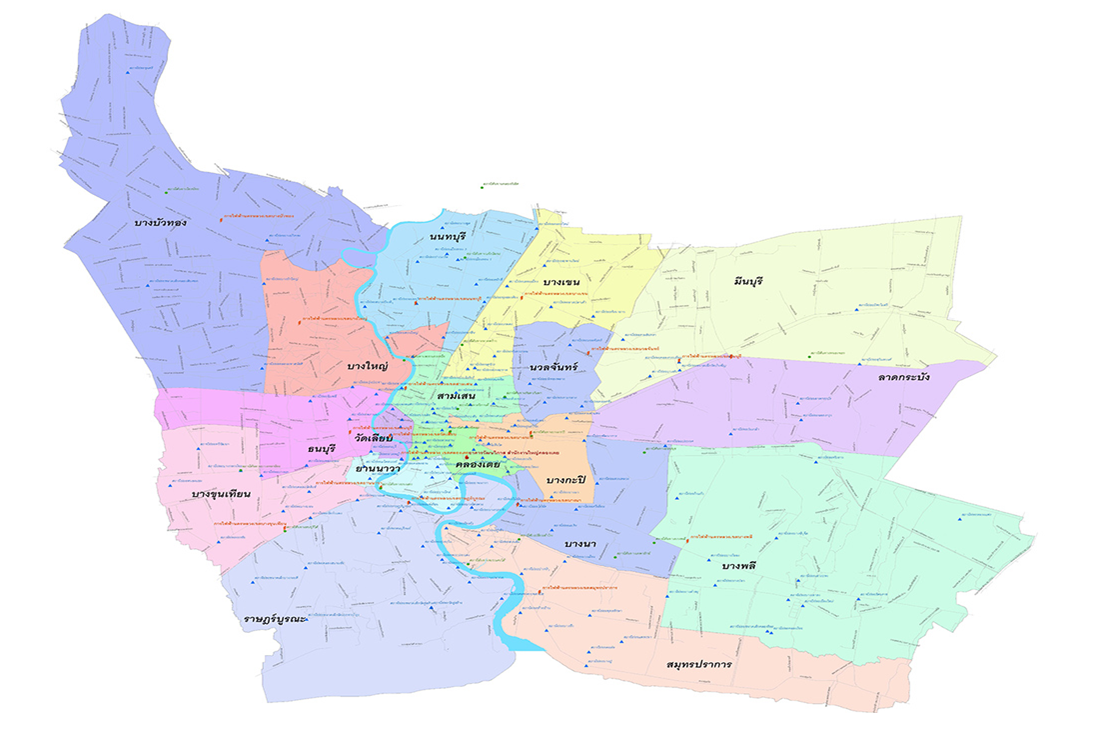
Map 1: Map of the Metropolitan Electricity Authority's power distribution area
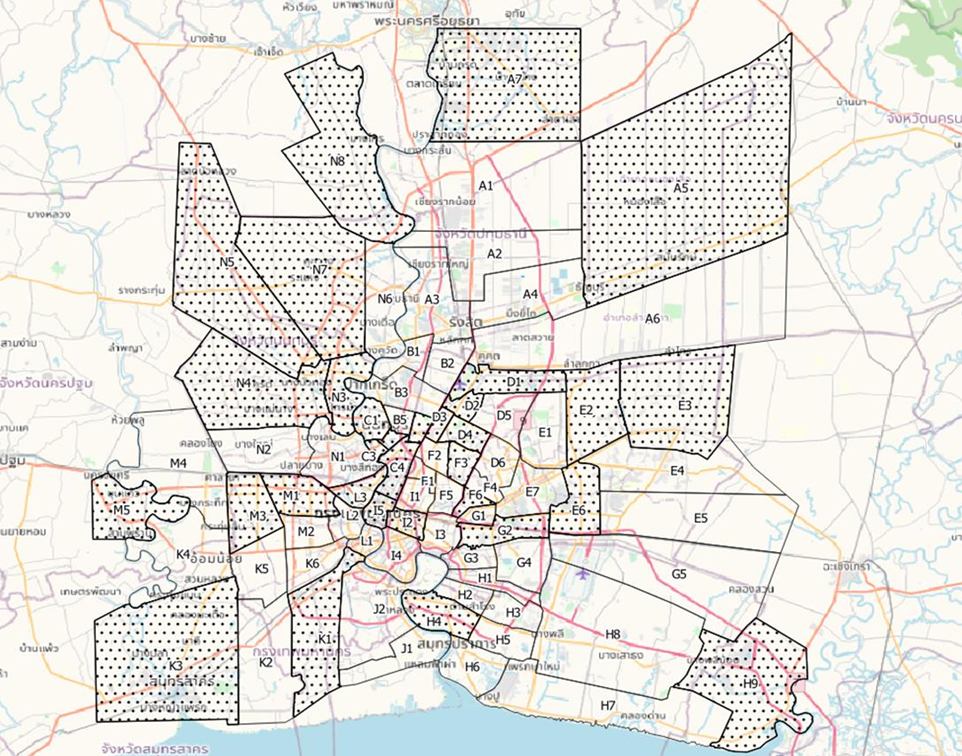
Map 2: Map of the housing market survey in Bangkok and its vicinity by Agency for Real Estate Affairs
Vacant Housing Markets in 2025
When using the data of the Electricity Generating Authority of Thailand (EGAT) together with housing markets lauching collected by Agency for Real Estate Affairs to cover the whole Bangkok Metropolitan Region, the data is more comprehensive and precise. However, the Bangkok metropolitan area does not include Nakhon Pathom city and only Sam Phran, Nakhon Chai Si (partly) and Phutthamonthon Districts. It does include parts of Ayutthaya (Bang Pa-in, Pratunam Phra In, and Rojana) and Chachoengsao (parts of Bang Wua), which are in the urban expansion zones of Bangkok.
In Bangkok and its vicinity, as of 2025, there will be a total of 6,390,376 residential units, and it is estimated that there will be Vacant Housings of 734,893 units, or approximately 11.5% of the total. The majority of vacant Housings, 58%, are condominiums, indicating that there is a lot of speculation in condominiums, resulting in a large number of vacant Housings, which can become an economic waste if they are not occupied as they should be. This is especially true in the case of low-rise houses, where the potential for loss is even greater, as there will be significant depreciation, especially if there are no residents at all.
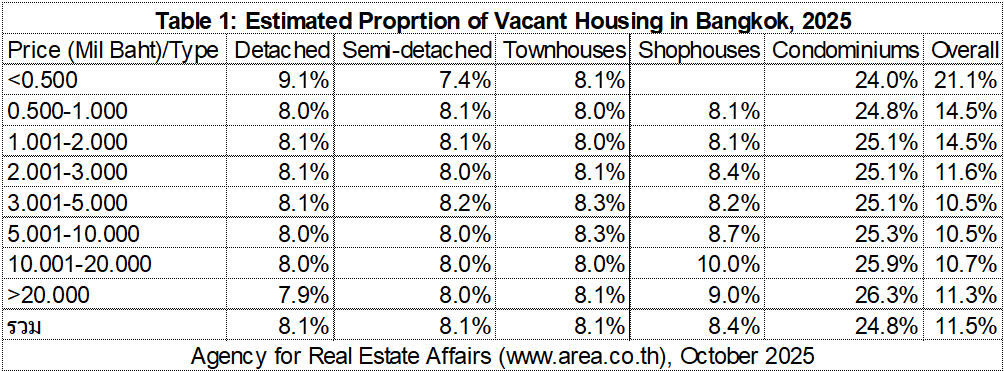
Another large group, around 24%, are townhouses. Next are detached houses, which are still vacant at 11%, shophouses or commercial buildings at 4%, and semi-detached houses at only 3%. Over the past decade, the number of newly launched condominiums has consistently been more than half, resulting in a particularly high proportion of vacant housing.
It can be seen that condominium units have a high proportion of vacant housing, as high as 24.8%, indicating that approximately one-quarter of the units are unoccupied. This is a very dangerous situation for residential condominiums. Meanwhile, low-rise housing units have a very low proportion of vacant housing because there are still many buyers. If there are too many condominium units launched in the future, it may make selling them more difficult.
Houses priced below Baht 2 million have a higher percentage of vacancy than those priced higher. Condominiums priced under Baht 500,000, in particular, have a high vacancy rate of 21.1%. These housing units may not be maintained properly because the full amount of maintenance fees cannot be collected. Low-income earners can purchase them, while speculators can buy them for rent or resell at a reasonable price too. The cheaper the housing prices, the more difficult to collect maintenance fee may be This results in the inability to maintain the properties properly resulting in a more deteriorated condition and hence more vacant units than those priced higher.
Nationwide Estimates
The number of housing units in other areas nationwide is 22,738,143 units. It is estimated that the vacant share in other areas nationwide is 4.0%, as rural areas are areas with actual residents. Therefore, the vacant number in other areas nationwide should be 909,526 units. In total, the total vacant number nationwide is 1,644,419 units (including those 734,893 units in the Bangkok Metropolitan Region).
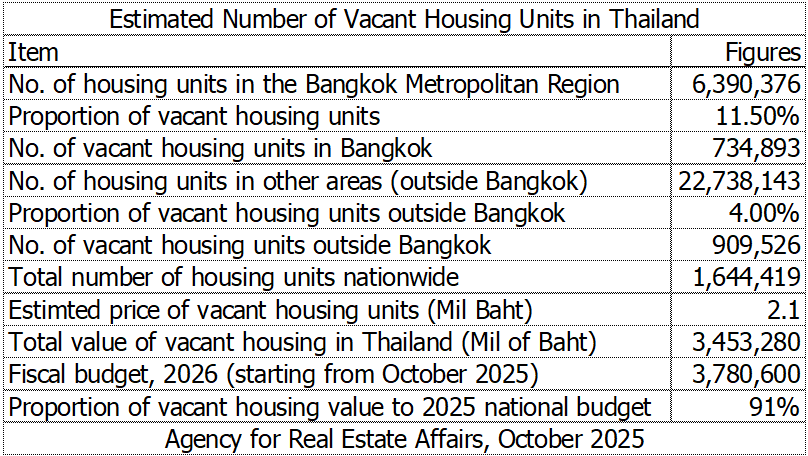
If the average price per unit is estimated to be Baht 2.1 million, the value of vacant housing units is Baht 3,453,280 million (USD 106.255 billion), which is equal to 91.3% of the 2026 national budget of Baht 3,780,600 million (USD 116,326 billion). Hence, the value of vacant housing units is as high as the Thai national budget.
International Comparison
While in Thailand there are 1.64 million vacant housing units, in other countries the number is similar, for example Korea has 1.5 million units, Japan has 8.9 million units, and China has 50 million units. The reasons why there are so many vacant housing units in Japan is because
1. The number of population has been decreased over time.
2. There are many vacant housing units in the countryside. Few people live there.
3. The houses of the new generation are often located in the city, are for singles or single parents. These vacant housing units do not meet their needs.
4. The cost of demolishing and building a new house is very expensive, so the house is left abandoned.
5. Because inheritance taxes are expensive, many people do not consider taking over the house but leaving it vacant.
6. If old, dilapidated houses are demolished and to be vacant land, the land tax will be six times higher than the land with houses on it. Hence, a lot of houses were left abandoned.
Conclusion and Recommendations
A high number of vacant housing units indicates a high level of speculation in the past, resulting in a significant amount of vacant housing, potentially resulting in economic waste if not utilized adequately. This is especially true for low-rise housing, as depreciation is significant. Furthermore, in cases where there are no occupants, the constant effort to build new housing will only increase the number of vacant housing units. Therefore, the government should find ways to help dispose of these properties, particularly second-hand ones, to stimulate economic circulation and benefit the nation.
Another solution is to levy a land and building tax on vacant housing to encourage their uses. Owners may be forced to sell or rent them out at a lower price than the original asking prices, making it easier for people to own a home without having to move to remote rural areas, benefiting all parties. If existing homes can be utilized, water and electricity supplies and other amenities and infrastructure may not be expanded endlessly to the fringe of Bangkok. Green and agricultural areas can be kept if there are fewer housing launched in the fringe as well.
Listen to Dr.Sopon Explaining 1.64 mil Vacant Housing Units in Thailand :
https://www.facebook.com/reel/4308759439450638
Listen to Dr.Sopon Explaining 1.64 mil Vacant Housing Units in Thailand :
https://www.tiktok.com/@dr.sopon4/video/7571403493131422983?lang=th-TH
Listen to Dr.Sopon Explaining 1.64 mil Vacant Housing Units in Thailand :
https://youtu.be/fpknuY5jihs
